1. The thesis
When you hand work to a machine, the only thing you hand it is words. It cannot see your office. It does not know your customers. It has your sentences and the names of things, and it treats both as true. So a name that is wrong is not a small untidiness — it is a false fact, fed into every piece of thinking that touches it. Not missing information: misinformation. A thing called a foundation gets treated as a foundation, and the machine builds on it. The claim everything here rests on is that language is therefore a working part of the system, with its own tests and its own upkeep, rather than decoration on top of one.
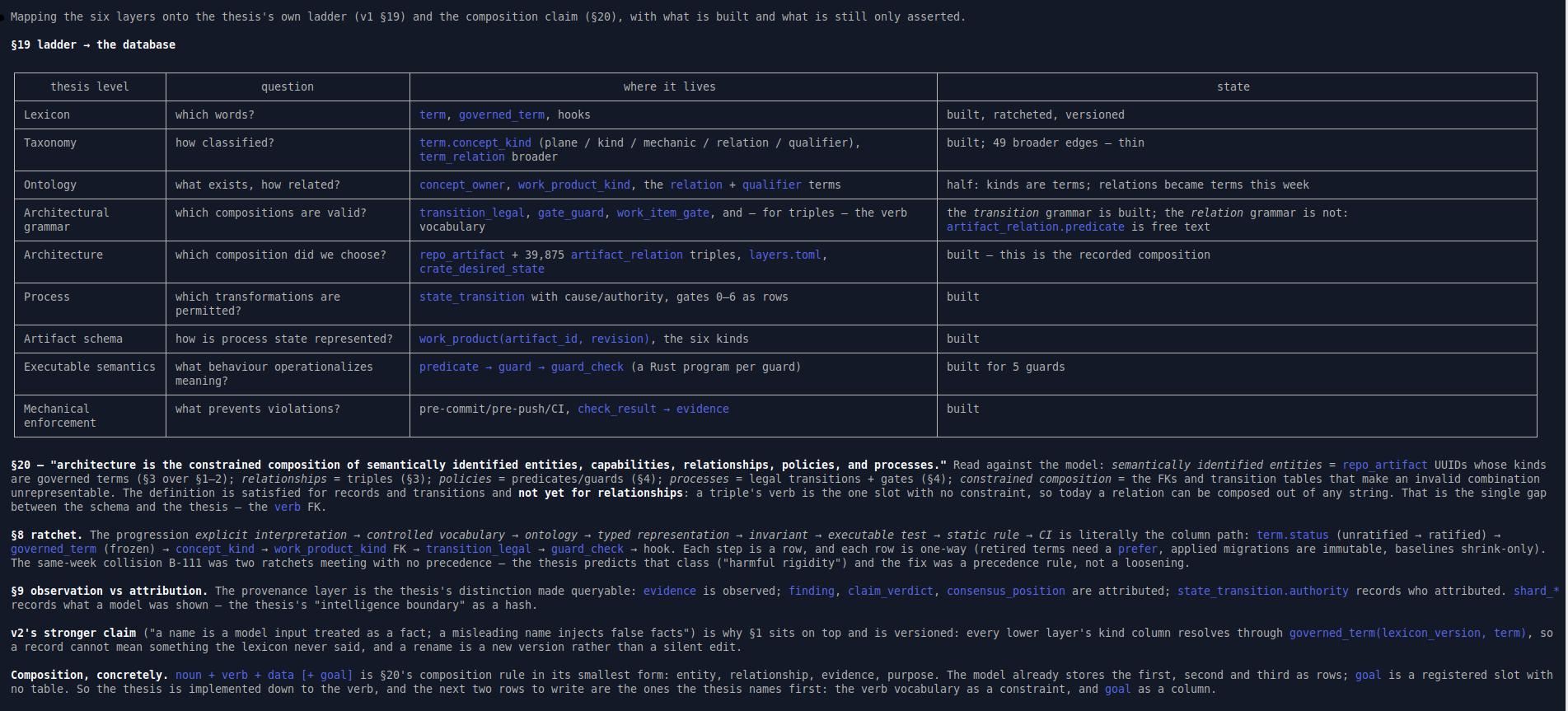
2. Lexicon — which words we use
Every team invents a private language without noticing. The same word ends up meaning two things — in one room a kind of customer, in the next room a step in a process — and nobody finds out until something built on one meaning is used by somebody holding the other.
Here each important word has one written meaning, and only one. It is a row in a database, not a note in a document. It says what the word means, what it does not mean, who decided, and when. Use a word against its meaning and the tools stop the work before it is saved.
A word can also be retired. When one turns out to be wrong, it is not quietly deleted — it is retired with a successor, so the record says what to write instead, and anybody reading the old word later finds out what happened to it.
3. Taxonomy — how the words are sorted
Above the stock of words sits the question of what kind of word each one is: a name for a thing, a name for a doing, a name for a rule, a name for a relationship between two things. Sorting them is not filing for its own sake. It is what lets a program ask whether a sentence is even shaped properly, before anybody argues about whether it is true.
4. Ontology — what kinds of things exist, and how they relate
Then the older and harder question: what sorts of things are there, really? A person is one kind of thing. So is an agreement, a place, a sum of money, an encounter between two people. None of those is the same sort of entry as a capability like searching, or keeping a record that cannot be altered — and pretending otherwise is how a system ends up with one table that means four things. What kind of thing something is gets decided before how to build it.
5. Grammar — which combinations are allowed
Knowing the words and their kinds still does not tell you which sentences are legal. A grammar does. Some things may rest on others and some may not. A rule may constrain a process; a process may change a state; a product is a permitted arrangement of parts rather than any old heap of them. This is where architecture stops being a diagram somebody drew and becomes a set of combinations a program can accept or refuse.
6. A person rules; a machine may only propose
A machine may notice that two words are being used for one thing. It may propose a better one, and set out the case. It may point at every place the old one appears.
It may not decide. That is not a house rule somebody could forget — the database itself refuses a ruling that comes from a machine. Meaning is settled by a person, and the settling is written down as a dated decision with a name on it. 252 words have been settled that way so far.
7. Observation, attribution, presumption
Three different things get muddled together constantly in ordinary writing, and keeping them apart turns out to matter enormously.
- What was observed. The drive did not spin. The column is missing. The test went red. Anybody can check it.
- What is attributed. Somebody's judgement about what it means — whose judgement is part of the claim, and is recorded with it.
- What is presumed. The gap between the two, quietly filled in. This is the one that causes the trouble, because it reads exactly like the first.
So an absent fact is written down as absent. A reading that could not be taken says it could not be taken. A part that was never checked says unchecked, not 'fine'. A machine that cannot see a serial number is made to say which way it failed — out of focus, wrong side up, obscured — from a short list of ways, so a person knows what to do about it.
8. Noun, verb, data — work written as parts of speech
Work itself is written in a small, deliberately boring shape borrowed from grammar. A thing, something done to it, and what comes out: noun, verb, data. Tom opens the spreadsheet. The spreadsheet gives customer rows. The rows go into a letter. Each of those is one link, and one link's data is the next link's noun, which is what makes it a chain rather than a pile. The noun is a governed word, not any word — so is the verb. The data is the concrete checkable thing, a row or a file or a number, which is how a program can tell whether it actually exists.
9. Goal — the part everyone forgets
A chain can be perfectly well formed and still be pointless, so there is a fourth part that belongs to the whole chain rather than to any one link: the goal. Why it is being done at all, stated before the work starts, in a form somebody can check afterwards. A sequence that produces a file but cannot say what the file was for is not allowed to close. And the goal is never marked by the same run that did the work — a piece of work does not get to grade itself.
10. Semantic sharding — showing the shape, not the contents
If words are what a machine gets, then the question of which words is a question about privacy as much as accuracy. A document is broken up on your own computer first, into its shape: how many parts, what kind, who spoke when, which fields are empty — with the names and the contents replaced by markers. That shape is usually enough to answer the question. The deposition never leaves the building; a description of its structure does. And which machine is allowed to see even that depends on what the material is. Every time anything crosses the line, a record is kept of exactly what crossed.
11. Measured, not believed
None of this would be worth much if it were only a belief about how machines read. So it was tested. Several models were shown nothing but the names of things and asked where each one belonged.
The best of them got 59% right. The cleverer one did worse, at 39% — and both made the same mistake, reading a name as a claim about importance that it was never meant to make. With names that told the truth, both were right every time.
That result is why this is engineering rather than taste. The measurement is published, along with the runs that went badly.
Where this comes from
For thirty years after graduating from Washington University, the English degree was the thing that came up at parties and nowhere else. Then machines arrived that take language as their input, and it turned out the useful training was the one that asks what a word actually refers to, whether two people using it mean the same thing, and what happens to an argument when they do not.
That is not a metaphor here. The vocabulary is a table you can query. Two words for one thing is a fault a program reports. The long version is the thesis.